

Change indeed is the only constant, and the corporate world is changing faster than ever before. Due to the COVID-19 pandemic, workplace norms have changed in ways we could never have predicted, and trying to keep up with the workplace trends can be difficult and exhausting, not to mention high-stakes.
The pandemic is still very much a reality for many of us in 2022. However, it’s fair to say that as we do our jobs, we’ve learned to adapt to new behavioral patterns and expectations in our work life. If we are among the millions of “knowledge workers” who have more freedom to choose when and where we work, we should make the most of the opportunity to achieve a better work-life balance.
Related articles:
The Future of HCM Technology: Closing the Functionality Gap
Future of Work: Trends and Insights of HR Management
What are Workplace Trends?
Trends in the workplace are anticipated business transformation that will develop and grow over time. These predictions are helpful because they enable us to get ready for the coming changes in the evolving workplace and become more agile. Once you are aware of the most recent changes in the workplace, you may adapt the way your business runs to stay ahead of the curve.
These business trends don’t come out of nowhere. In order to find out what employees want from their employers, market research, surveys, trend data, and employee interactions are used to inform these decisions. Although we lack a crystal ball, you can rest confident that these forecasts are far more than just a wild guess as to how offices may look in the future workplace.
The goal of identifying trends is to notify employers of industry shifts and assist companies in creating more progressive workplaces.
Employers can improve company culture, increase employee retention, and defeat workplace passivity by adapting to trends and investing in their employee experience.
Why is it Crucial to be Aware of Future Job Trends?
Market and industry trends change throughout time. Over time, the environment as a whole is changing. As a result, business leaders will need to keep up with business-related developments that impact the bottom line.
We can strive to understand it and allow businesses time to prepare, even though we can’t entirely avoid it. In the end, these developments help companies achieve a competitive advantage, which is the major reason why they should be aware about the future of trends incorporated in the workplace.
Employee engagement and happiness at work rise, which in turn lowers turnover and increases job satisfaction.
7 Top Workplace Trends that Should be Adopted
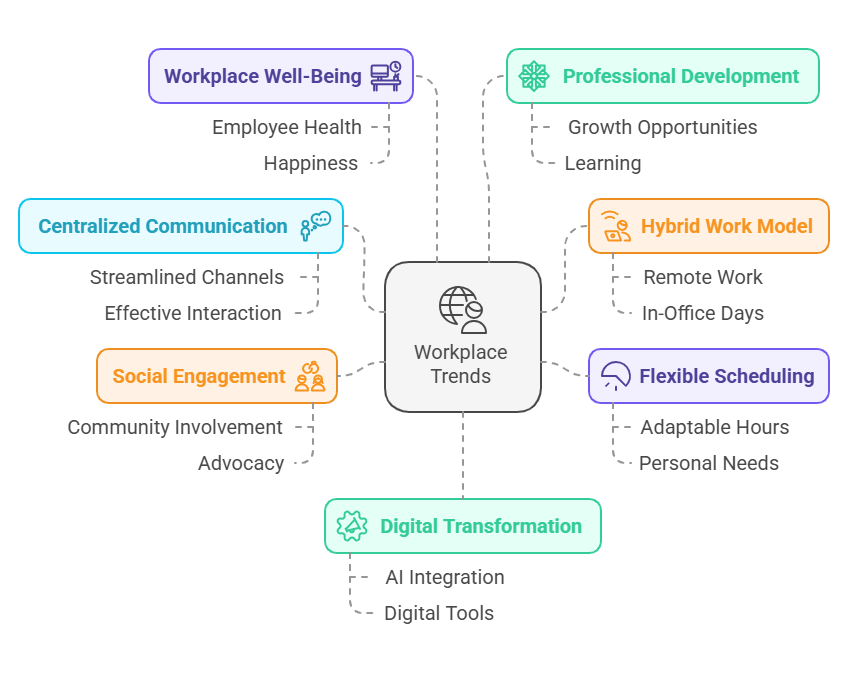
1. Focus on Centralized Communication
A current tendency in the workplace is toward communication that is more centralized and organized.
Centralized communication will continue to be a top priority to fight communication overflow and misinterpretation among team members as teams become more spread across time zones and geographic regions. Productivity rises when teams are easily able to collaborate with their co-workers and communicate effectively with their supervisors.
For these reasons, a lot of companies are adopting streamlined work management and integrated communication channels. Consolidation of communication channels can help clear up an uncertainty or, worse, a complete absence of communication, giving workers the knowledge, they need to perform at their best.
2. A Hybrid Model of Work
A hybrid work model has been adopted by many companies to accommodate varying employee preferences when it comes to physical workspaces vs remote work. A hybrid workforce may consist of one day per week at the company’s headquarters, two days at a coffee shop, and two days telecommuting from home. It could also mean spending two days per month in the company’s office and the rest from a remote location. Employees essentially have the freedom to choose where they do their best work.
These models aren’t going away anytime soon, as businesses strive to provide more flexible work structures while remaining competitive in the market. For example, they can expand their talent pool and hire tech talent in LatAm.
3. Skipping the 9 to 5
Workplaces are no longer required to have a fixed 9 a.m. to 5 p.m. schedule. Employers are giving the much-needed flexibility that top talent are searching for when choosing a firm to join. This is done by allowing employees to alter their time to earlier or later in the day based on commuting hours, school pick-up schedules, or doctor’s appointments. Some organizations are even adopting a 4-day work week into their work policies. An employee can simply change their day’s schedule to accommodate an early-morning dentist visit rather than taking paid time off.
This trend started as a way to cater to the work preferences of Millennials, but soon organizations that employees overall have benefited from flexible work arrangements.
4. Social Engagement and Advocacy
Doing what you can to help those less fortunate is more than just a reputation boost for businesses. It is becoming important for current and potential employees that the organization cares about the community it serves. Offering community service hours or even going as a group to volunteer at a local organization is a good way to attract new talent that share the same values and to encourage teamwork.
5. Prioritizing Workplace Well-Being
Employers should place a high value on well-being, which can be defined as the condition of being at ease, healthy, or happy. When our mind, body, and sense of purpose make us feel good about ourselves and pleased with our lives, we are in a state of well-being.
Businesses are viewing employee well-being as a quantifiable consequence, a crucial business input, and a concrete asset. To achieve this, HR professionals have implemented new technologies and human resources initiatives across the entire employee lifecycle:
1. Offering and matching expectations of the job seekers during talent acquisition and the hiring process
2. Making employees feel welcomed and cared for during onboarding
3. Developing skills through learning and development
4. Perks, benefits, and rewards for all employees
5. Safe and pleasant work environment
6. Leveraging employee feedback
6. Personal and Professional Development
Learning (especially e-learning) has been a very important topic when it comes to the future of work. Employees desire to take charge of and participate in their growth and development.
Employers who provide strong resources and opportunities for personal and professional growth not only give their staff the opportunity for growth they desire, but also enjoy several advantages such as decreased turnover and retention rates, better access to world class talent, and increased employee engagement. That’s critical for the health of your business and acquiring top talent through recruitment marketing.
It has also become important to ensure that professional development is more inclusive than it has ever been before. For employee performance to thrive, career development has now extended to those working remotely as well as contingent workers such as freelancers and independent contractors who work from home.
7. Digital Transformation and Artificial Intelligence
Digital transformation has become an important part of every business strategy. Some companies are using machine learning to predict things like absenteeism rates and candidate fit into the workplace culture. Artificial intelligence can also be used to detect and alert HR about skill gaps in the organization and identify disengaged and engaged employees.
Managers and employees have also adopted the use of chatbots to facilitate many HR processes such as answering common payroll questions or taking periodic employee experience surveys.
Conclusion
The last several years have shown us that the future is highly unpredictable and may not turn out the way we expect. But you shouldn’t be concerned about the unforeseen. Companies today are building their organizational culture around agility and investing in innovations that enable business leaders to react quickly when a disruption does occur. If you keep these modern workplace trends in mind, whether it’s now or next year, you’ll succeed in solving whatever issue you encounter at work.