Artificial Intelligence (AI) is increasingly becoming a game-changer in various industries, and Human Resources (HR) management is no exception. With AI, HR departments are transitioning from conventional, manual processes to more streamlined, automated operations.
AI is being used today in many HR technology to streamline recruiting, staffing, talent management, HR analyitcs, workforce planning, and more.
This article delves into 12 compelling statistics that highlight the profound impact of AI in HR, illustrating how this technology is revolutionizing talent acquisition, employee engagement, and numerous other HR functions.
Related articles:
What You’re Missing on Conversational AI in the Workplace
The Best Use Cases for HR Workflow Automation
The Impact of Automation and AI on HR
- By 2030, automation poses a potential risk to 47% of jobs in the US, 35% in the United Kingdom, and also 35% in Germany. (Statista, 2021)
- Employers who have automated parts of their talent acquisition and management processes are highly satisfied with the outcomes. A staggering 93% report significant time savings and improved efficiency, while 67% indicate cost and resource savings. (Career Builder Survey)
- Highly automated companies are 6 times more likely to achieve revenue growth exceeding 15% compared to companies with low automation. (ServiceNow, 2017)
- According to recent findings, 60% of business leaders plan to enhance their HR department with increased AI and automation within the next 5 years. Additionally, an impressive 61% foresee the possibility of AI taking over HR functions, especially with the advancements in generative AI technologies like Chat GPT. (Personio, 2023)
- 85% of companies have expedited their digitalization efforts in response to the COVID-19 pandemic. (McKinsey Global Business Executives Survey, 2020)
- According to 2023 data, 74% of business leaders acknowledge the need for increased efficiency and productivity in their organizations. Additionally, 66% of these leaders believe that AI and automation hold significant potential to address these challenges within the HR department.(Personio, 2023)
- According to Gartner, 69% of routine managerial tasks will be fully automated by 2024.
- Only 37% of HR employee services and 33% of customer issue resolutions are automated, compared to 53% for IT services. This indicates the need for improvement across all areas.(ServiceNow, 2017)
- 43% of respondents express concern over potential job loss due to increased automation in the HR function. (Personio, 2023)
- According to SHRM (the Society for Human Resource Management), approximately 25% of organizations utilize automation or artificial intelligence (AI) to assist with HR-related tasks.
- Approximately 2 out of 3 HR professionals report improved time-to-fill for open positions, with 53% stating it is somewhat better and 16% indicating a much better outcome. This positive impact is attributed to their utilization of automation and AI. (SHRM)
- According to a study, 85% of employers who utilize automation or AI report time savings and increased efficiency. (SHRM)
Generative AI development company solutions are accelerating HR transformations by optimizing talent acquisition, enhancing workforce analytics, and automating administrative workflows, ensuring HR teams focus on strategic initiatives rather than repetitive tasks.
How HR Can Prepare for AI Implementation
Evaluate how AI will impact jobs
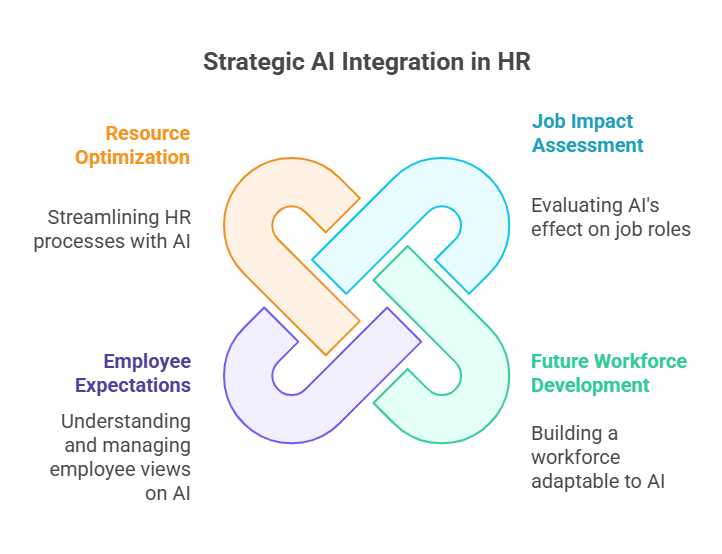
HR managers can evaluate how AI will impact jobs at their organization by undertaking a comprehensive job roles and tasks assessment. This involves determining which tasks within each job role can be automated, followed by an analysis to understand the impact of this automation on the role itself.
Managers can use tools like process mapping and AI-readiness assessments to visualize and quantify this impact. Additionally, they should consider the skills that their workforce needs to interact with AI systems effectively. Training and development programs may be necessary to ensure employees can leverage these new technologies.
Furthermore, an impact assessment can help identify potential risks and mitigation strategies, such as job redesign or reskilling initiatives, to prepare for the transition to AI-enhanced workflows.
Define a future proof workforce
HR managers can define a future-proof workforce by focusing on skills development and continuous learning. A proficient workforce in the era of AI will need both technical skills to operate new tools and soft skills like problem-solving, adaptability, and critical thinking, which are less likely to be replicated by machines.
Identifying core skills required for the future and investing in upskilling and reskilling initiatives can help maintain workforce relevance. Encouraging a culture of lifelong learning where employees are motivated to continuously update their skills can also play a crucial role.
Finally, employee well-being should be an integral part of this forward-thinking approach. This includes recognizing the importance of mental health in maintaining productivity and engagement levels. By taking these steps, HR managers can not only define but also effectively build a resilient, future-proof workforce.
Understand employee expectations
Understanding employee expectations about AI entails open communication and feedback channels. HR managers should conduct regular surveys, focus groups, and one-on-one discussions to gather insights on employees’ views about AI implementation.
These might include their readiness, perceived benefits, concerns, and suggestions for smooth integration. Regular communication can also help dispel AI myths and manage expectations effectively.
Additionally, analytics tools can provide valuable data on employee interaction and satisfaction with AI systems. By understanding and addressing employees’ expectations, HR managers can foster a more accepting and cooperative environment for AI adoption.
Identify resource-intensive processes
Identifying resource-intensive HR processes is a critical step towards the effective implementation of AI in the HR department. HR managers can start by conducting a comprehensive audit to pinpoint areas that consume substantial time, effort, and resources.
These may include recruitment and selection processes, payroll and benefits administration, performance management, and employee relations. It’s also crucial to consider processes with high error rates or those that require substantial manual input.
Once these areas are identified, managers can evaluate the potential for AI integration. AI can be particularly beneficial in automating repetitive tasks, reducing human error, and streamlining complex workflows.
For instance, automate resume screening in the recruitment process with AI or simplify benefits administration by providing personalized employee assistance. By identifying and targeting resource-intensive processes, an HR manager can optimize efficiency and productivity through AI integration.
Conclusion
In conclusion, the integration of Artificial Intelligence (AI) in Human Resources (HR) heralds a transformational era for organizations. From preparing the workforce for this shift to identifying and optimizing resource-intensive processes, AI has the potential to revolutionize the HR landscape.
From the hiring process to compensation and benefits, AI in HR can help you reach your business goals. It can also improve talent retention, develop strategic HR initiatives and build your competitive advantage.
Crucially, this shift can lead to high levels of efficiency, accuracy, and productivity in people management. As we progress further into the future of work, it’s imperative we continue to explore, adapt, and innovate in tandem with these technological advancements.
To learn more about the practical applications of AI in HR, or if you’re interested in implementing AI in your HR department, contact us today. Let’s shape the future of HR together.