We set goals in our daily lives, in order to attain a certain target and accomplish our tasks. Similarly, within an organization the HR department can utilize SMART goal setting processes to help you achieve your company’s goals and objectives. Implementing actionable goals into work processes helps employees become accountable which motivates them to finish tasks in a timely manner. SMART HR goals should be created with the objective of using them to attain your company-wide targets. Aligning the SMART HR goals with your company’s strategy and vision in mind, will optimize results. Read on, to learn what exactly SMART HR goals are, why they’re important for your company, best practices to implement them and lastly followed by a few examples!
Related Articles:
HR Measurement: Everything You Need To Know About HR Metrics
Which KPIs to Optimize for HR Management?
What are SMART HR Goals?
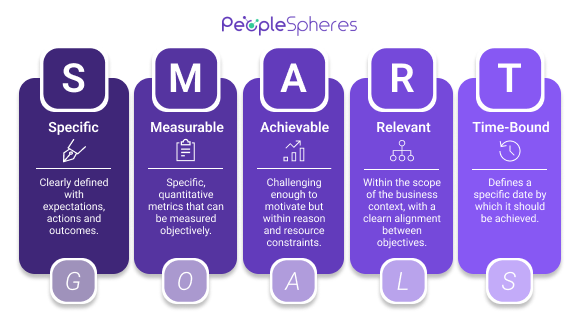
SMART goal setting is a technique that is utilized to help set clear outlines which makes it more effective to reach objectives. SMART HR goals, has an acronym that summarizes what this technique consists of. The SMART goal setting process consists of:
S: specific, M: measurable, A: attainable, R: relevant, T: time-bound
1. Specific: Setting specific goals is very important because it ensures that the objective is clear and not vague. In order to make sure that it’s specific, the goal statement should define who, what, where, when, why and how. This aids in outlining what the clear outcome is supposed to be and helps employees understand the goals better.
2. Measurable: The goals should be measurable so that you can track your progress and success. In order to achieve this, set a clear criteria that will align with how you want your success to look like. This includes making the goal quantifiable. For example, I want to increase revenue by 20% is a measurable goal rather than just stating you want to increase revenue.
3. Attainable: The goal should be achievable and have reasonable factors backing it up including your company’s capabilities, skills, and resources.
4. Relevant: The goals that are set should align with your company’s long term objectives and contribute to success. Don’t confuse goals with objectives, these goals should align with the long term picture. A relevant goal will motivate employees to stay on track as well.
5. Time Bound: Goals can be short term, long term or for the lifetime of the company which can be broken down further. Many companies lose focus on goals because they don’t have clear deadlines. Goals that have clear deadlines, keep employees and managers accountable to finish their work.
SMART HR goals can be used strategically to improve goal setting processes at your company and can help you achieve long term success.
Why are SMART HR Goals Important?
SMART HR goals will increase focus and productivity. This is because when the goals are set using this technique, they are specific which gives employees a clear vision and encourages them to get the tasks done. Further, setting such goals helps prioritize tasks that are most important for a company because with this process, relevant and time bound goals will be set.
By implementing SMART HR goals, you will be able to enhance your company culture. This is because specific and measurable goals will create a positive working atmosphere and cultivate better work relationships. Due to the time bound manners of all the goals, it will make all the processes more effective and efficient which will further boost company culture.
With SMART HR goals, HR will be able to set specific hiring goals which will allow for better organizational management. For example, setting applicable hiring deadline dates will ensure that they’re not falling behind. Additionally, setting short and long term SMART HR goals will also aid the HR managers in preventing procrastination and low productivity rates in employees. Overall employee experience can also be improved because SMART HR goals will make sure budgets are made effectively which have more room for employee rewards. Better employee rewards and recognition will further boost employee productivity, which in turn contributes to the company’s success.
Best Practices for Setting SMART HR Goals?
Now that we know what SMART HR goals are and what their importance is, the next question that may come up is, how do we implement them?
To start the implementation of SMART HR goals, you have to first make sure that your HR missions are aligned with key findings in the HR department. This means, if you have an issue in the HR department, make it into a goal of how you will fix that and how you want to improve it, using the outlined SMART goal method above. This approach will ensure that there is effective goal setting in place that tackles the current issues and problems the department is facing.
Further, you can also implement SMART HR goals for areas of improvement. You may find that there aren’t huge problems in the department but there could be places that can use some improvement where such goals can be implemented. Along with setting SMART goals, you have to create a plan that will show everyone how you will go about achieving the goal. This can be done by having an effective HR platform and performance management system that gives employees all the information about the goals in one place. The platform can have a dedicated space for employees to see their performance (especially in terms of their assigned goals) and training sessions that need to be done.
SMART HR Goals Examples:
Amongst the many HR goal examples, we’ve picked 4 SMART HR goals that hold a lot of importance and appeal.
SMART Goals for Employee Retention:
Any HR department will understand that hiring employees is an extremely time consuming process. We want to make sure that our company is able to retain and keep our valuable employees. Improving employee retention is important in order to maintain company culture, productivity and save on additional expenses. A SMART goal for employee retention may be: “We want to retain our top employees and increase retention rate by 15% from previous year.”
In order to achieve this your specific and measurable goal would be that you want to improve retention rates by 15%. In order to make this goal achievable you mention that you will conduct employee surveys and gather feedback to figure out why employees leave, adjust rewards and holidays, ensure that employees are motivated and update skills by having personal meetings with them and implement more HR team members to make the process smoother. The relevant aspect would be that it’s important to retain top talent and save costs. This goal is also time bound because it’s set to happen within a year.
SMART Goals for Employee Engagement:
When your employees feel valued at the company, they will work with one another in harmony and sync to achieve your company goals. A smart goal would be: “Within the next 3 months, the company will boost employee engagement by 5 points by adding employee rewards and recognition.” This is specific, measurable and timely as it mentions an increase of 5 points within 3 months. It’s achievable because it outlines how it will be done, which is through rewards and recognition, and you can also add that you will have more personal meetings with employees to make them feel valued or take help of a consultant to do so. It’s relevant because employee engagement boosts morale and productivity.
SMART Goals for Recruitment Costs:
Recruitment costs can be a heavy investment for a company, therefore strategies that can help reduce it will always be beneficial. A smart goal would be: “We want to reduce recruitment costs by 10% by the end of this year. We will do this by improving employee retention, offering competitive pay, and conducting surveys and meetings to hear employee feedback.” This is specific, measurable, and time bound because it mentions reducing recruitment costs by 10% by the end of this year. It’s achievable because there is a clear action plan outlined for how to achieve it. It’s relevant because reducing recruitment costs benefits the entire company and saves their time.
SMART Goals for Talent Acquisition:
HR managers need to keep an eye out for evolving hiring trends and what skills are needed in their company as technology increases. This will give them a better idea for what their company is looking for in a candidate. A SMART goal in this area would be to “Increase the amount of active job openings being filled by the deadline by 12%, by the end of this year.” This is specific, measurable and timely because we want a 12% increase in active job openings being filled by the deadline by the end of the year. It will be attainable by keeping up with hiring trends and company needs. It’s a relevant goal because hiring good candidates in a timely manner benefits the overall company.